

I ran into an old friend in the lobby of our church a few Sundays ago. She and her husband had been in seminary with us and we’d just lost track of each other. As we caught up with each other over lunch the next week, she described the devastating journey of the last twenty years: some fruitful years of ministry, a growing unease and feeling that something wasn’t quite right, the discovery of a series of affairs and then their divorce. Hearing her recount her pain was heartwrenching.
The number of couples that started ministry with us and have flamed out (from moral failure), burned out (from resource depletion), faded out (from gradual discouragement) or blown up (from a relational/emotional explosion) is astounding. It’s tempting to just focus on the discouragement this brings. But it’s brought Craig and me to conversations and understanding about why this is so prevalent…and what we can do to keep it from happening to us…because we aren’t so naive as to believe it couldn’t.
Craig put our thinking into a multi-article series for the pastors’ network he leads and I just HAD to share some of it. We pray it opens up some conversations for you and your spouse as you seek to run the race to the end – together.

Why Managing Your Margin Matters in Ministry
It’s a depressing number.
I’m not just talking about how many Christian leaders have had spectacular moral failures, the people who blew up their ministries with unimaginable choices. I’m also not just talking about how many Christian leaders have burned out and given up.
Individually, each of those two statistics is deeply concerning, but put them together and the number of used-to-be-pastors is truly depressing.
You might wonder if adding the burnouts and the blowups together is really fair, but I think it’s not only fair, I think it’s necessary. I think failing to do so obscures the source of an epidemic. I think failing to do so keeps us coming up with solutions that, at best, only address the symptoms and, at worst, actually contribute to the source.
I think we have to think of the burnouts and the blowups together for two reasons.
First, the end result is the same. Of course the moral connotations are different, but the practical implications are identical: they were called, but they are no longer qualified. The harvest is still just as plentiful, but the workers are now fewer.
Second, I believe the burnouts and the blowups are actually different consequences of the same cause. There are exceptions, of course, but after 34 years in vocational ministry, after watching countless burnouts and blowups among my friends and fellow ministers of the Gospel, after years of coaching pastors and consulting with churches trying to pick up the pieces, I’ve come to a surprising conclusion:
Whether the exit was a slow depletion or a sudden explosion, the underlying mistake was a failure to manage the margin.
What Is Margin, and How Does It Prevent Burnout?
Here’s how I think about margin: margin is the gap between what’s available to you and what’s asked of you. It’s the difference between the resources you have and the resources that are required.
Think of margin like the shocks on a car. What makes them work is the gap, the space between the two halves. That’s the “absorber” in the “shock absorber”. The top half is what’s available to you. The bottom half is what’s asked of you. And the margin is the gap between those two things:
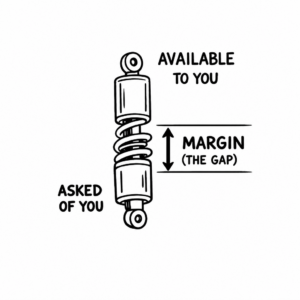 As the car moves along the road and hits small (or big) bumps or potholes, what’s asked increases and decreases moment by moment. But as long as there’s a gap, a margin, between what’s asked and what’s available at any given moment, everything is fine.
But the more you weigh the car down, the more you decrease the gap. And the more you decrease the gap/margin, the less you have available to you for the inevitable bumps in the road. And now, what would have felt like a little dip starts to do some damage.
If there’s too little margin and too big a bump, the damage can be instantly catastrophic. The tires can explode, the struts that hold the engine can break, the whole thing can fall apart in one spectacular disintegration. That’s the blowup.
But it’s more common that the damage is slow and subtle; a microfracture here, a loosening of the bolts there. Keep driving a car with too little margin in the shocks and, while it might take some time, there’s going to be a day when the pieces start coming off or it just doesn’t start. One day you go out and turn the key and nothing happens. Or you get it started but when you try to put it into gear, there’s just a grind. You can’t think of any big bump that could have caused the breakdown, because there wasn’t a big bump. There were just a lot of little bumps with no margin to absorb them without transmitting them to the frame, the engine, the transmission. That’s the burnout.
And that’s why margin matters.
Resisting Temptation Requires Resources
It’s very tempting to attribute moral failures to pride, to arrogance, to a lack of Christian character. In fact, it’s tempting to look at those who blew up their marriages, ministry, and lives and question if they really had the Spirit of God in the first place. Maybe they did such an un-Christian thing because they weren’t really Christians.
The reason that’s so tempting is because it means we don’t have to worry about the same thing happening to us. Because we know the Spirit of God is in us. We know we didn’t go into ministry to prey on young women or get famous or amass a personal fortune.
If they gave in to temptation because they were terrible, then I don’t have to worry about giving in to temptation because I’m not terrible…right?
But what if…and just entertain the possibility here with me for a second…what if they weren’t terrible? What if they were tired?
What if, instead of being despicable people who went into ministry for deplorable purposes, they were just…depleted? What if what was being asked of them had exceeded what was available to them and the lack of margin had taken its toll?
That’s an unpleasant possibility to consider because we’re not terrible…but we do get tired, don’t we?
Have you ever decided to eat better and then had a little setback? A bag of Doritos that certainly must not have contained the advertised amount because there’s no way you ate that whole thing yourself? A second slice of cheesecake?
Or maybe you committed to getting to the gym more often and you were killing it…until you broke your streak?
Or maybe you decided to stop buying Starbucks every day to help save up for a trip and then you broke down and went anyway?
Now think about when you’ve given in to those small temptations. Chances are it was when you hadn’t slept well, or when you’d had a series of hard conversations, or when you got some bad news. Let’s be real: bad days break good habits.
But why?
Because willpower isn’t something we forge, it’s something we fund.
The way we talk about it, willpower sounds like something we summon out of nothing, the product of an act of creatio ex nihilo, calling the strength to resist temptation into existence by the sheer might of our iron will itself.
But nothing could be further from the truth. We don’t create willpower, we allocate resources to it. We have to fund that resistance. And that requires resources.
The devil knows this.
That’s why he didn’t even try to tempt Jesus until Jesus was hungry, tired, depleted. Was Satan uninformed about who Jesus was or was he just really stupid? Did he really think he could get the Son of God – clearly not a terrible person – to do a terrible thing? Or did he just know that tired can turn into terrible more easily than we care to admit?
When Ministry Burnout Solutions Add to the Problem
The failure to understand this reality often leads to, at best, well-meaning, but ultimately unhelpful advice. At worst, the solutions make the problem worse.
For most of my life, I’ve been told that the best way to avoid a blowup is to “have an accountability group”.
Look, accountability is important, but the way we try to create it – or what it is that the group is trying to hold us accountable for – often not only fails to address the real problem, it can actually contribute to it.
I remember once, as a young youth pastor, I handled something with a volunteer badly. I was harsh and lacked grace in addressing a mistake that had been made. I make no excuses for that. I was wrong. In response to my leadership failure, a couple of the older men told me, “you need an accountability group. We’ll hold you accountable.”
What did that look like? We met once a week at 5:30 am for an hour.
The problem was that one of the main reasons I popped off at the volunteer in the first place was that I was running on fumes. I was doing full-time work as a youth pastor and worship pastor for a growing church while attending seminary full time. I was exhausted.
Now, let me be clear: none of that excuses my sin, but it definitely contributed to my lack of self-control in the heat of the moment with that volunteer.
And the “solution” of making me show up to a 5:30 am meeting once a week before I headed off to seminary for a day of classes before I headed back to the church for youth group…well, let’s just say that the solution not only failed to address a core part of the problem, it made it worse.
If, as I’m suggesting, blowups are often the result of not having enough margin in your life, adding more things that cut into that already depleted margin isn’t going to make anything better.
Similarly, to avoid burnout, we tell pastors things like, “you have to make sure you’re ministering out of an overflow of your own relationship with God.” And listen, that’s absolutely good advice. It’s crucial. It’s non-negotiable. But what does that mean, practically, for most people?
It means more personal prayer…even if you have to get up an hour earlier to make it happen.
It means more personal Bible-reading…even if you have to go to bed an hour later to find time for it.
And because it’s really hard to know how much is enough, most of us live with a constant worry that we’re not being spiritual enough. And that worry is even more weight we have to carry. It’s another ask eating into what’s available.
Have you ever noticed that one of the Big Ten is about having a rhythm of rest? I’m talking about the Sabbath. What’s interesting about the Sabbath is it’s all about what NOT to do, not about what to do.
Maybe we should pay some attention to that.

Rest and Spiritual Health in Ministry
I’m going to say something that probably sounds heretical, but after all these years in vocational ministry I’m not convinced that being more “spiritual” is as helpful as we seem to think it is.
One of my favorite men in the world, Larry Osborne, an incredibly effective pastor and leader I’m deeply honored to call my mentor and friend, once gave me this piece of sage advice: “Do your best, and take a nap.”
The thing is, while that may not sound very “spiritual”, let’s not forget that when Elijah was so depleted (because he spent what God gave him on work for which it wasn’t intended…but we’ll get to that another time), that he wanted to die, an angel showed up with instructions that basically boiled down to “Have a bite to eat and take a nap.”
And when that didn’t fix the problem? “Do it again.”
What does that mean?
It means that one of our most important tasks in ministry is managing our margin. It means that making sure there’s more available to us than is being asked of us is every bit as essential as our personal relationship with Jesus. And it means that, while your personal relationship with Jesus is one of the critically important ways you make sure there’s something in the tank, it is not the only thing you need to be paying attention to.
How do we manage our margin? How do we make sure there’s a gap between what’s available to us and what’s asked of us?
It starts with understanding how important it is. For many, it’s a philosophical shift that has to happen before any practical stuff becomes possible.
What I’ve prayed God would enable me to do with this article is convince you of the importance of learning to manage your margin. My hope is that you see more clearly now why your margin matters.
So how do you manage it? We’ll tackle that in part 2.

Recommended Resources
 BEHOLDING SO WE CAN BECOME: CREATING MARGIN IN THE LIFE OF A PASTOR’S WIFE | ALONGSIDE MINISTRY WIVES
 CREATING AND MAINTAINING MARGIN SO YOU CAN BE GENEROUS | ALONGSIDE MINISTRY WIVES

ZEAL WITHOUT BURNOUT: SEVEN KEYS TO A LIFELONG MINISTRY OF SUSTAINABLE SACRIFICE | CHRISTOPHER ASH