

Introduction to Margin in Ministry
This is the second part of a series on margin in ministry. These two articles are the product of a bunch of conversations that Craig and I have had on date nights, car rides, and in between the craziness of full ministry lives. This is the stuff “I wish they’d told me” back in our early days of ministry. Now that we have so much in the rearview, I believe this truth is one God has used to preserve us THROUGH the storm. May it do the same for you. (Oh, and if you missed Part 1, read Part 1 first)
Managing Your Margin, Part 2 – The Rhythm of Rest
Ok, let’s do a quick recap.
Margin is the gap between what’s available to you and what’s asked of you. It’s like the shock absorber in a car:
 As long as you have a gap, you can handle the bumps.
If the gap goes away, the bumps will start to do some long-term damage.
So now the question is: how do we manage our margin?
There are really only two things we can do to manage our margin: we can increase what’s available and we can decrease what’s asked:
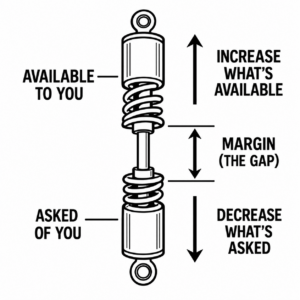
Increasing Your Margin Through a Rhythm of Rest
Look, I’m a guy, which means that I’m secretly convinced that reading an instruction manual will lead to the confiscation of my man-card. But just yesterday Coletta and I were putting together a fairly complicated piece of machinery and eventually I had to give in and accept that it wasn’t going to work right if I didn’t read the manufacturer’s instructions.
Maybe we should do the same with our lives.
So let’s look at the instruction manual:
By the seventh day God had finished the work he had been doing; so on the seventh day he rested from all his work. (Gen 2:2)
The Hebrew verb translated here as “rested” is shabat, from which comes shabbat or, as we write it, Sabbath. While it certainly can mean “rest”, it’s important to remember that the God who “also made the stars” (Gen 1:16) didn’t exactly need a nap. The primary meaning of the term is to cease activity. God wasn’t resting because he was worn out. He was simply hitting pause. The big question is, why did God pause his work if he wasn’t tired?
Because he was modeling what he would later mandate:
“Remember the Sabbath day by keeping it holy. Six days you shall labor and do all your work, but the seventh day is a sabbath to the LORD your God. On it you shall not do any work, neither you, nor your son or daughter, nor your male or female servant, nor your animals, nor any foreigner residing in your towns.” (Exo 20:8-10)
Of course, God didn’t need a break from his work, but we do, so he practiced what he would later prescribe for us: he sabbath-ed.
I don’t know about you, but I grew up with a fundamental misunderstanding of the fourth commandment. I thought God gave us the Sabbath command because he wanted something from us: our worship.
Then one day I noticed what Jesus said:
Then he said to them, “The Sabbath was made for man, not man for the Sabbath. (Mark 2:27)
Apparently, God didn’t institute the Sabbath command because of what he wants from us but because of what he wants for us. And what he wants for us is right there wrapped up in the word he used: sabbath. God wants us to rest.
The first way we can increase what’s available is simply by following God’s instruction to have a rhythm of rest.
By the way, I say “rhythm of rest” because God didn’t say “when you’re feeling really worn out, take a breather.” What he said was that we need to rest on a regular basis, whether we’re feeling really tired or not.
It’s important to think about rest and rhythm together. Too often, we talk about balance, and I think that’s a mistake.
In my opinion, balance is energy-consuming. It’s about getting everything piled up just so and then praying nothing touches our carefully balanced stack.
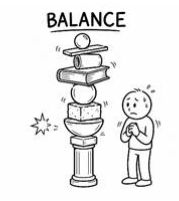
The only way balance can persist is if nothing of substance ever gets added in or taken away. But because things are always getting added in or taken away, the reality is that maintaining balance is an active process. It requires constant adjustments and tweaks.
Go balance the end of a broom on your hand and see how much work it takes to keep even that single item in balance.
Balance is energy-consuming. Balance is exhausting.
And when God said to rest every 7th day, he wasn’t prescribing balance. After all, he didn’t say work 3.5 days and rest 3.5 days.
Taking every 7th day off to rest isn’t balance; it’s rhythm.
And rhythm, unlike balance, is energy-contributing.
Think about a steady drum beat. I don’t mean the monotonous (even ominous) steady pounding of a single deep drum (like in the mines of Moria). I mean a good drummer making use of all the parts of a kit. There’s some kick drum here and then the crack of a snare there. The tap-tap-tap on the hi-hats – sometimes open, sometimes closed – keeps everything in time. Every now and then there’s a little fill on the toms. Even without hearing it out loud, you can feel your foot start tapping and your head start bopping, can’t you?
That’s what I mean when I say rhythm is energy-contributing. It gives life.
By the way, rhythm is also a sign of life. Think about the sound of a heart monitor. You definitely don’t want the pitch and frequency of that sound to be in balance – eeeeeeeeeeeee – that’s the sound of death. You want regularity. You want rhythm – beep, beep, beep, beep – right?
The thing about rhythm is that it’s really about appropriateness. It’s about what’s appropriate now and what’s not appropriate now. God said that work is appropriate for six days, but on the seventh day, it’s not appropriate.
This concept of rhythm-as-what’s-appropriate is expressed clearly in Ecclesiastes:
There is a time for everything, and a season for every activity under the heavens:
a time to be born and a time to die, a time to plant and a time to uproot,
a time to kill and a time to heal, a time to tear down and a time to build,
a time to weep and a time to laugh, a time to mourn and a time to dance,
a time to scatter stones and a time to gather them, a time to embrace and a time to refrain from embracing,
a time to search and a time to give up, a time to keep and a time to throw away,
a time to tear and a time to mend, a time to be silent and a time to speak,
a time to love and a time to hate, a time for war and a time for peace.
(Ecclesiastes 3:1-8)
This passage tells us that rhythm is about seasons and what’s appropriate in them. It’s appropriate to plant in the Spring and harvest in the Fall. It’s not appropriate to try to harvest in the Spring or plant in the Fall. It’s appropriate to mourn at a funeral, but not to dance. But then the season for dancing comes around and mourning isn’t appropriate.
This passage also tells us that rhythm is about seasons and that seasons come in lots of sizes. Planting season and harvesting season aren’t the same size…and of course they’re separated by another good-sized season: summer.
On the other hand, the season for silence and the season for speaking might each happen multiple times in a single conversation.
In other words, there are macro-seasons, and micro-seasons.
Micro-Seasons: Daily and Weekly Rhythms of Rest
Work six days and rest on the seventh is a micro-season, but there are even smaller micro-seasons still defined by what’s appropriate and what’s not.
For instance, I’ve realized that when I go home at night, there are things that are no longer appropriate, like checking email. But other things like hanging out with my wife and maybe doing a little woodworking are appropriate.
By the way, I think we need to talk for a second about the idea that God only mandated one day off each week. In our culture, we typically have two days off (i.e. the weekend), but this doesn’t necessarily mean that we’re out of rhythm when it comes to rest. First, in the ancient world, work typically started after sunrise and ended before sunset. It ended before sunset so people could get home and have time with their families before everything went dark. Without electric lights, it was pretty hard to do much of anything once it got dark, so most people just went to sleep.
Can you imagine that? Can you imagine big parts of the year where you went to bed at 7 pm and got up at 7 am?
My point is simply that for most of human history, there was a lot more rest built into the micro-seasons of each day. But in an era where we can work from home, and work late into the night, we’ve lost a lot of that daily rest. So I don’t think having two days off each week violates the principle God gave us. If you can get two days off, you probably need them…and you probably still need to figure out how to get an appropriate amount of rest at the end of the other 5 days, too!
Personally, I haven’t had two days off on a regular basis in a long time. Our church does a Saturday afternoon service, so I spend most of Saturday at the church. What that means is that I have learned to be very deliberate about stopping work at appropriate times Monday through Thursday so that I’m actually getting enough rest.
This also means that I think very intentionally about not just what’s appropriate (and not) in those micro-seasons, but that I think intentionally about larger macro-seasons in my life.
Macro-Seasons: Planning Rest Around Ministry Demands
Macro-seasons may be a significant part of a year, or even of a whole lifetime, like the season of starting your ministry or the season of retiring from it. Having kids at home is a relatively long season with different opportunities and demands than the empty-nest season.
No matter what the season is or how long it is, it’s important to think about what’s appropriate (and what’s not) in that season.
A few years ago, I realized that a season of adjusting to a new ministry position was coinciding with another macro-season where I still had children at home. In reflecting on that, the Holy Spirit led me to see that some of what I had been doing in the previous season was no longer appropriate for the current season. So I pressed pause on writing books, accepting outside speaking engagements, and teaching seminary classes.
Macro-seasons may also be parts of a year. As a pastor, I know that Christmas and Easter are busy seasons. Launching a new campus or initiative, or doing a capital campaign are also high-demand seasons that may take up several months in a year. Knowing that these seasons will ask more of me than other seasons, I have learned to be intentional about planning an appropriate amount of rest before and after those seasons so that there’s enough available during those seasons and in the next ones. This might involve taking weekends off, week-long vacations, or at least work weeks where I go home earlier more days.
Why We Justify Ignoring Sabbath Rest
Rest is not only necessary; it’s commanded.
And let’s be real: the command to have a rhythm of rest isn’t just 1 of the 613 commandments traditionally recognized by rabbinic Judaism. It’s one of the top 10, right?
So why is it likely to be the only one of the Ten Commandments you’re not obeying? And why is this commandment the only one we feel justified in disobeying?
I don’t know about you, but for me, I used to have theological, strategic, and practical justifications.
Theological Justifications
Theologically, I felt like I could argue that Jesus didn’t “obey” the Sabbath command. After all, the Apostle John, under the inspiration of the Holy Spirit, literally says:
For this reason they tried all the more to kill him; not only was he breaking the Sabbath, but he was even calling God his own Father, making himself equal with God. (John 5:18)
I know a lot of people want to say that Jesus didn’t “break the Sabbath” but rather he only broke the Pharisees’ interpretations of – or additions to – the Sabbath command. But that interpretation of this verse doesn’t work. If John had meant to say that Jesus was challenging the Pharisees’ legalism, he could have easily said that, and did so in multiple other places within his gospel.
Perhaps more importantly, John actually mentions two reasons why the Pharisees wanted to kill him: he was “breaking the Sabbath” and he was “calling God his own Father, making himself equal to God.”
Was the second accusation true? Of course it was. But if the first accusation wasn’t true, by bundling it with the second accusation, John would have been undermining Jesus’ claim that God was his own Father. Plus, John explicitly says “not only” was he breaking the Sabbath, “but also” he was calling God his own Father. That sentence literally depends on both accusations being true to make any sense.
So from my perspective, I felt like I had a good theological reason for not really paying much attention to the Sabbath command. Jesus didn’t, and I’m supposed to be like Jesus, right?
What I missed, of course, was that even though Jesus might have “broken” the letter of the Sabbath command in its initial form, he absolutely obeyed its spirit. He rested.
In fact, Jesus often rested even when there were a lot of pressing demands for his attention.
Yet the news about him spread all the more, so that crowds of people came to hear him and to be healed of their sicknesses. But Jesus often withdrew to lonely places and prayed. (Luke 5:15-16)
Very early in the morning, while it was still dark, Jesus got up, left the house and went off to a solitary place, where he prayed. Simon and his companions went to look for him, and when they found him, they exclaimed: “Everyone is looking for you!” Jesus replied, “Let us go somewhere else– to the nearby villages– so I can preach there also. That is why I have come.” (Mark 1:35-38)
Reading those verses, my “theological” justification for not resting enough completely falls apart.
Strategic Justifications
Strategically, I thought that not resting would set a good example for the rest of my staff. After all, how could I expect them to have a great work ethic if I wasn’t modeling it by being there earlier, later, and more often than anyone else?
The biggest problem with that strategy is that the rest of my staff won’t feel the impact of the “big bumps” the same way I will. When there’s a crisis at the church, or a big opportunity, the weight of that will fall more on me than on them. Many of the crises that keep me awake they’ll be able to leave at the door when they go home. Many of the opportunities the Lord puts in our path will require me to put in longer hours while the workload on the staff remains essentially the same. I’m not saying it’s all on me, I’m just saying that the weight of both crises and opportunities isn’t distributed evenly.
So if I’m not managing my margin, I’m actually not being strategic.
Practical Justifications
Practically, I just thought I had too much to do to make rest a priority. But then God started to show me that not all my work was equally important. Some of my work had dramatically more impact than the rest of it. Preaching, for example. Visioneering. Developing staff.
As God began to teach me this, I began to realize that not everything I was ignoring God’s command to rest in order to do actually needed to be done. Or, at least, it didn’t have to be done by me. More on this later.
What I’m saying is that my justifications for ignoring God’s command to have a rhythm of rest weren’t…well, justified.
And yours aren’t either.
Letting Go of Guilt About Resting
But even if you recognize that the justifications aren’t justified, there’s probably still a part of you that still feels wrong about resting. You feel guilty.
I get it…but you shouldn’t.
At the risk of slipping into proof-texting, let me share a verse I can’t seem to get away from when I think about this topic:
There remains, then, a Sabbath-rest for the people of God; for anyone who enters God’s rest also rests from their works, just as God did from his. Let us, therefore, make every effort to enter that rest, so that no one will perish by following their example of disobedience. (Heb 4:9-11)
Look, I know the Sabbath-rest in this passage is a lot bigger than the kind of rest we’ve been talking about. The rest in this passage is Gospel-rest. It’s continued faithfulness to Jesus who said “Come to me, all you who are weary and I will give you rest”-rest. It’s the eternal hope-of-heaven-rest. Absolutely.
But…the articulation of the promise of this rest is built on precisely the principle of rest we have been talking about. So while they’re distinct, they’re also intertwined and that makes me think that the “example of disobedience” isn’t just refusing to trust in Jesus, it’s also refusing to follow the example Jesus established when it comes to rest.
So maybe, instead of feeling guilty for having a rhythm of rest, we should feel guilty for not having one.

Recommended Resources on Margin and Rest
 The Art of Rest: Faith to Hit Pause in a World that Never Stops | Adam Mabry